Welcome to Matrix Education
To ensure we are showing you the most relevant content, please select your location below.
Select a year to see courses
Select a year to see available courses
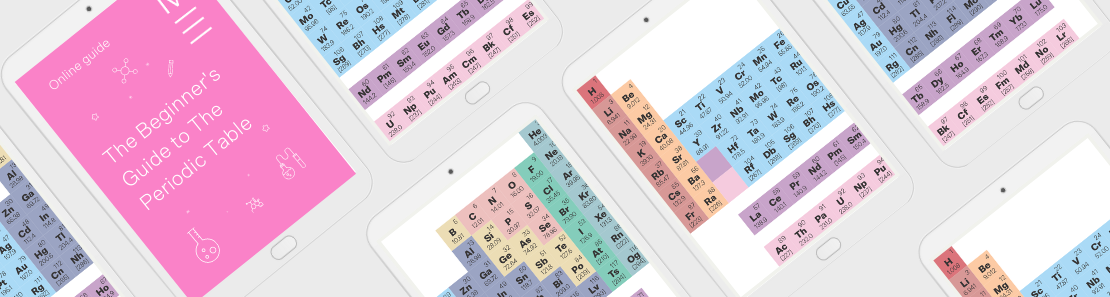
Struggling to make sense of the periodic table beyond “chemistry chart with a lot of boxes”? This guide explains what it is, how it is organised, and how to read it the way a NESA marker expects you to.
The periodic table is a chart that arranges every known chemical element by atomic number, the count of protons in the nucleus. Elements with similar properties line up in the same column because they share the same number of outer, or valence, electrons. That repeating pattern of properties is why chemists call it “periodic” in the first place.
An element is a substance made of only one type of atom, and that atom’s proton count is what identifies it. Hydrogen has 1 proton, helium has 2, carbon has 6. Almost everything you touch day to day, water, table salt, the aluminium in a drink can, is a compound built from two or more elements bonded together. A handful of elements, gold among them, turn up in pure form in nature.
That same valence electron count is what Year 9 Chemistry builds its reactions and bonding work on, so a shaky grip on the table here tends to show up as a shaky grip on chemical equations later.
The International Union of Pure and Applied Chemistry (IUPAC) is the body that confirms a new element’s discovery and approves its name, and an element does not appear on the table until IUPAC has done both.
A period is a horizontal row. Every element in a period has the same number of electron shells, and each one has one more proton than the element before it. Move from left to right across Period 3, for instance, and you go from the reactive metal sodium to the near-inert gas argon in eight steps.
A group is a vertical column. Elements in the same group have the same number of valence electrons, which is why they tend to react in similar ways. Group 1, the alkali metals, all form a +1 ion and react vigorously with water. Group 17, the halogens, all form a −1 ion.
| Period | Group | |
|---|---|---|
| Direction | Horizontal row | Vertical column |
| What lines up | Number of electron shells | Number of valence electrons |
| What it predicts | How atomic size and reactivity shift left to right | How chemical behaviour repeats down the column |
| Example | Period 3: Na to Ar | Group 1: Li, Na, K, Rb, Cs, Fr |
Metallic character falls as you move left to right across a period, and rises as you move down a group. Metals cluster on the left and in the middle. Non-metals sit on the right. A staircase of metalloids, elements such as silicon and germanium that behave partly like both, runs diagonally between them, so the metal to non-metal boundary is a gradient rather than a hard line.
Three trends do most of the work in a Year 9 or Year 10 exam answer.
| Trend | Across a period (left to right) | Down a group |
|---|---|---|
| Atomic size | Shrinks, as more protons pull the same shell in tighter | Grows, as each row adds a new electron shell |
| Reactivity of metals | Falls | Rises |
| Reactivity of non-metals | Rises | Falls |
Reading these two trends together explains why francium, bottom left, is the most reactive metal on the table, and fluorine, top right, is the most reactive non-metal. If you want the full picture of how this fits against Biology and Physics as a subject choice, our Biology vs Chemistry vs Physics guide breaks down what each senior subject actually involves.
Trends like these are exactly what Matrix’s Year 9 Science course builds on in its Reactions and Materials work. The term course runs 9 weekly 1.5 hour lessons that teach the next school term’s content early, with a printed theory book, weekly homework with feedback, and a topic test at the end of term.
On campus or online. Nine weekly lessons, $747 per term. First Lesson Money-Back Guarantee.
View the Year 9 Science course
Mendeleev gets the credit, but he built on decades of earlier attempts. In 1789, French chemist Antoine Lavoisier sorted elements into basic categories: gases, metals, non-metals and earths. In 1862, Alexandre-Émile Béguyer de Chancourtois arranged elements by atomic weight into a spiral and noticed their properties repeated. English chemist John Newlands then proposed his Law of Octaves, in which every eighth element shared similar properties, much like notes in a musical scale. German chemist Julius Lothar Meyer grouped elements by valence in 1864, which is closer to how the modern table works.
Mendeleev published his table in 1869, ordering elements by atomic weight and leaving deliberate gaps for elements no one had found yet. Three of his predicted elements, later identified as gallium, scandium and germanium, turned up within his own lifetime and matched his forecast closely. That predictive power is why his version, not the earlier ones, became the standard.
Mendeleev did not know about protons or electron shells. Scientists reorganised the table around atomic number rather than atomic weight only in the 1950s, once atomic structure was properly understood, giving us the version taught today. The most recent change was not structural: on 28 November 2016, IUPAC formally named elements 113, 115, 117 and 118 nihonium, moscovium, tennessine and oganesson, completing the seventh row.
Working out which of these predictions held up, and why, is a good example of the scientific method in action: propose a model, test it against new evidence, and revise it when the evidence demands it.
The periodic table is not a side topic. Under the NSW Science 7-10 Syllabus (2023), which NESA has implemented from 2026, “Periodic table and atomic structure” is one of eight named Stage 4 focus areas, taught alongside Forces, Cells and classification, and Solutions and mixtures. It sets up two Stage 5 focus areas that follow it directly: Materials and Reactions.
That structure matters for how you should revise it. Get the table itself solid in Year 7 and 8, because Year 9 and 10 assessment tasks assume you can already read it fluently and spend their marks on what you do with that knowledge, not on the table’s layout. Our Year 9 Science Syllabus (NSW, 2026) guide sets out what that Stage 5 assessment actually covers, topic by topic.
There are 18 groups. Some share little beyond a column number, like the noble gases sitting next to the reactive halogens. Others are similar enough that chemists group them under one name, like the transition metals.
| Groups | Common name | Number of elements | What they have in common |
|---|---|---|---|
| Group 1 (Hydrogen and alkali metals) | Hydrogen and alkali metals | 7 | Highly reactive metals (excluding hydrogen), one valence electron, form +1 ions |
| Group 2 (Alkaline earth metals) | Alkaline earth metals | 6 | Reactive metals, two valence electrons, form +2 ions |
| Groups 3-12 (Transition metals) | Transition metals | 38 | Hard, dense, good conductors, form coloured compounds |
| Groups 13-16 | (No single name) | 24 | Wide range of metals, metalloids and non-metals, including carbon and silicon |
| Group 17 (Halides) | Halogens | 6 | Highly reactive non-metals, one electron short of a full shell, form −1 ions |
| Group 18 (Noble gases) | Noble gases | 7 | Low reactivity, full outer electron shell |
| Lanthanoids | Rare earth metals | 15 | Similar reactive metals, usually shown as a separate row below the main table |
| Actinoids | Actinide metals | 15 | Radioactive, includes uranium and plutonium, also shown as a separate row |
Transition metals are worth knowing by name because they turn up constantly in Year 9 and 10 practicals: iron, copper, zinc and silver all sit in Groups 3 to 12. Group 1 and Group 17 share a single valence number each. The transition metals share something different, a pattern of filling an inner electron shell, which is also why so many of their compounds are coloured. Matrix’s Year 10 Science course works through this material as part of its Chemical World content, and it carries straight into Year 11 Chemistry the following year.
These five account for most of the marks lost on periodic table questions, and they are worth adding to your own revision notes rather than relearning them the week before a test.
| Mistake | What to do instead |
|---|---|
| Reading the table by atomic mass | Order runs by atomic number, the proton count. Mass and number usually rise together but are not the same measurement. |
| Mixing up periods and groups | Periods are rows, groups are columns. If you keep confusing the two, say the words out loud: “period” and “horizontal” both have an “r”, “group” and “column” do not. |
| Treating metal and non-metal as a hard line | The metalloid staircase, boron down to astatine, sits between them. Elements near it, like silicon, share properties of both. |
| Assuming all Group 18 elements never react | Most noble gases are effectively inert under normal conditions, but heavier ones such as xenon do form compounds under specific lab conditions. Say “low reactivity”, not “never reacts”. |
| Naming Groups 13 to 16 as one family | Unlike Group 1 or Group 17, this block has no single shared name or valence pattern. Describe individual elements rather than the block as a whole. |
The periodic table is a chart that organises all 118 confirmed chemical elements by atomic number, electron configuration and recurring chemical properties. It is arranged into horizontal rows, called periods, and vertical columns, called groups.
An element is a substance made up of atoms that all have the same number of protons in their nucleus. That number is the element’s atomic number, and it is unique to each element, from hydrogen at 1 through to oganesson at 118.
A period is a horizontal row. Every element in a period has the same number of electron shells, and atomic size, reactivity and other properties change gradually as you move across it from left to right.
A group is a vertical column. Elements in the same group have the same number of valence electrons, which gives them similar chemical properties and similar reactions.
Transition metals are the elements in Groups 3 to 12, including iron, copper, zinc and silver. They are typically hard, dense, good conductors of heat and electricity, and known for forming brightly coloured compounds.
There are 118 confirmed elements. The most recent four, elements 113, 115, 117 and 118, were formally named nihonium, moscovium, tennessine and oganesson by IUPAC on 28 November 2016, completing the table’s seventh row.
Dmitri Mendeleev published the first widely adopted periodic table in 1869, arranging elements by atomic weight and leaving gaps for elements not yet discovered. It was reorganised around atomic number in the 1950s, once atomic structure was better understood, to give the version used today.
You do not need to memorise the periodic table cold. You need to be able to read it under exam conditions and use it to answer a Reactions or Materials question in Year 9 or 10, or to carry that foundation into Year 11 and 12 Chemistry. Matrix’s Science courses teach the next school term’s content early, in small classes capped at 15, with weekly homework marked and returned with feedback.
On campus at Matrix’s Sydney campuses, or online through Matrix+. Term 1 2027 begins 12 October 2026. First Lesson Money-Back Guarantee.
Matrix Education is the leading tutoring college for Year 3 to 12 students. For more foundational science guides, visit the Science 7-10 blog hub.
© Matrix Education and www.matrix.edu.au, 2025. Unauthorised use and/or duplication of this material without express and written permission from this site’s author and/or owner is strictly prohibited. Excerpts and links may be used, provided that full and clear credit is given to Matrix Education and www.matrix.edu.au with appropriate and specific direction to the original content.