Welcome to Matrix Education
To ensure we are showing you the most relevant content, please select your location below.
Select a year to see courses
Select a year to see available courses

Join 75,893 students who already have a head start.
"*" indicates required fields

Join 8000+ students each term who already have a head start on their school academic journey.
Victorian students return to school on 28 January 2027, six days after the January holiday courses finish. This is how to use that fortnight, and what the Years 7 to 10 courses actually cover at Box Hill.
English, Maths and Science, taught as separate blocks over four days at two hours a day. For Years 7 to 10 the work is revision and consolidation of content the student has already met, rather than running ahead into the next year’s material. Each subject is its own block, so a student can take one or build a week around two.
In English the holiday blocks are built around writing, with text analysis alongside the forms students are asked to produce. In Maths the emphasis falls on exam preparation and on the techniques that carry into the following year. Science covers chemical and biological concepts at the level the year group has been working at.
| Years 7 to 10 | Years 11 to 12 (VCE) | |
|---|---|---|
| Length | 4 days, 2 hours a day | 5 or 9 days, 3 hours a day |
| What it does | Revises and consolidates | Covers a full term of VCE content |
| Subjects | English, Maths, Science | English, Mathematical Methods, Specialist Mathematics, Biology, Chemistry, Physics |
| Relationship to the term course | Supports it | Is it, compressed |
The two brackets share the word “holiday” and do opposite jobs, which is the distinction most families miss. A Year 9 student is consolidating. A Year 11 student is covering next term’s VCE course.
They begin on Monday 11 January 2027. Victorian government school students return on Thursday 28 January, so the gap between the end of the course and the first day back is about a week.
| Date | What happens |
|---|---|
| Monday 21 December 2026 | Victorian government school summer holidays begin |
| Monday 11 January 2027 | Matrix January holiday courses begin at Box Hill |
| Wednesday 27 January 2027 | Victorian school Term 1 begins for teachers |
| Thursday 28 January 2027 | Term 1 begins for Victorian government school students |
| Thursday 25 March 2027 | Victorian Term 1 ends |
That six-day gap is worth planning around and it is one of the real differences between the two states. A Victorian student finishes a January course and is back at school the following week, so whatever was covered is still fresh. A New South Wales student has nearly a fortnight, which is long enough that the last few days of the course need deliberate revisiting. The Victorian calendar does that work for you.
The Victorian Government term dates page carries the official dates, and our own Victorian school holidays and term dates page sets them out alongside the Matrix calendar. Note that independent and Catholic schools sometimes set their own start dates, so check yours.
Most Victorian students do not, and that is worth saying plainly. A student who finished the year tracking along, who hands work in and reads over summer, will not be transformed by eight hours in January, and six weeks is the only properly unstructured stretch in the Victorian school year.
Where a holiday course earns its place, it is usually one of three situations.
A specific topic never landed. Something the student can name and you can name, that has been a problem through the year and will be assumed knowledge in the next one. Four consecutive days suits one stubborn thing better than a term of weekly lessons does.
A transition year is coming. Going into Year 10, where subject choice starts to shape the VCE pattern, or into Year 11, where the jump to Units 1 and 2 is the largest in Victorian schooling. Arriving steady in the fundamentals leaves room for everything else that is new.
The year ended badly. A report that dropped or an exam that went wrong. The useful part here is often confidence as much as content, and a small class where things go right again does more than pressure at home.
If none of those fits, let them have the summer. Our Year 7 and Year 10 pages set out what the term courses cover if starting in late January suits you better.
Related course: January 2027 holiday courses at Box Hill, Years 7 to 10
Four days, two hours a day, in small classes taught by experienced Matrix teachers at the Box Hill campus. English, Maths and Science are each their own four-day block, so a student can take one subject or two.
Courses begin Monday 11 January 2027 and finish before Victorian schools return on 28 January. Timetables and current fees are on the holiday courses page, and the Box Hill campus page has directions and parking.
A term course runs nine weekly lessons across nine weeks and teaches a term of content ahead of the school. A Years 7 to 10 holiday course runs four consecutive days and consolidates content already taught. One builds across the year, the other repairs or firms up something specific.
| Term course | Holiday course, Years 7 to 10 | |
|---|---|---|
| Shape | 9 weekly lessons over 9 weeks | 4 daily lessons over 4 days |
| Content | A term of the subject, taught ahead of school | Revision of material already covered |
| Best for | Sustained progress through the year | One identified gap, or a confidence reset |
| Free trial available | Yes | No |
The trial point matters because families reasonably assume an offer covers everything, and it does not. Free trials apply to term courses. Holiday courses and Matrix+ online courses are both excluded. If you want to see a Matrix class before committing to a holiday course, trial a term course once Term 2 opens in late January instead.
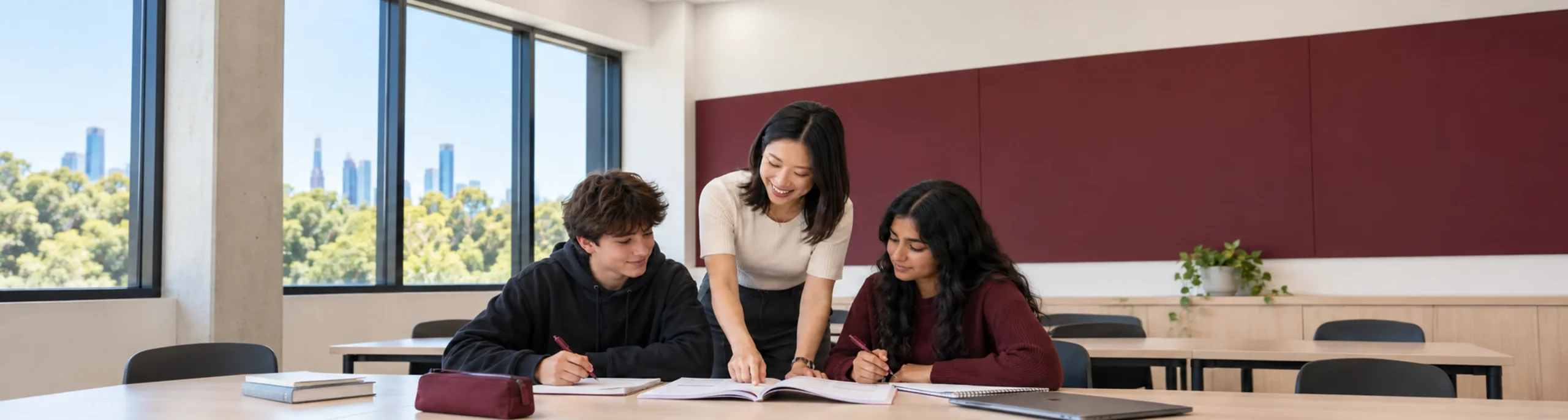
Two hours, one subject, one teacher, in a small class seated in a U-shape so everyone can be seen and drawn into the discussion. The two hours run closer to a long school lesson than to a tutoring session: teaching at the front, worked examples, then practice while the teacher moves around the room.
What makes four days work is that they are consecutive. In a weekly lesson a student meets a topic and then has seven days to forget it. Across four consecutive days, Tuesday builds on Monday while Monday is still fresh, and by Thursday the thing that was difficult on Monday has been revisited three times. That is the argument for an intensive, and it is why eight hours in a week does more than eight hours spread across a term.
Homework is set between days and it is short, since there is one evening to do it in. Its job is to show the teacher what has not landed so the next morning can start there.
All Victorian holiday courses run at Box Hill, at 6 Ellingworth Parade. Matrix has one Victorian campus, so there is no choice of location to weigh up, and families travelling from further out in Melbourne should check the timetable before booking rather than after.
Enough that advice written for Sydney does not transfer cleanly, and the summer break is the clearest example. Victorian students get about five and a half weeks between 21 December and 27 January. New South Wales students get about six, from 18 December to 27 January, and return a week later on 3 February.
| Victoria | New South Wales | |
|---|---|---|
| Summer holidays 2026-27 | 21 December to 27 January | 18 December to 27 January |
| Students return | Thursday 28 January 2027 | Wednesday 3 February 2027 |
| Gap after a January course ends | About six days | About twelve days |
| Year levels Matrix teaches | Years 7 to 12 | Years 3 to 12 |
Two things follow. The shorter Victorian gap means content covered in January is still fresh on the first day back, so a Victorian family gets more out of a late-January course than a Sydney family would. And because Matrix teaches Years 7 to 12 in Victoria, there is no primary offering here at all, which is the question Victorian parents of younger children ask most often.
The term calendars also diverge later in the year. Victorian Term 1 2027 ends on 25 March and Term 2 begins on 12 April, which is a different pattern from New South Wales, so a Sydney-written study plan will put the holidays in the wrong place. Our Victorian term dates page lists the Matrix calendar alongside the school one.
Rest, then read. The Victorian summer break is about five and a half weeks, shorter than the New South Wales one, and the single most useful thing a student can do with it is arrive in late January without the fatigue they carried out of December.
Three things repay the time.
Reading the student chooses. Anything they will finish. For a Year 9 or 10 student heading toward VCE English, a habit of finishing books is worth more than any holiday worksheet, because the senior course rewards readers who are used to sitting with a long text.
Maths fluency, in small doses. Ten minutes a few times a week, not an hour on Sundays. Maths decays faster than anything else over a break because it depends most on recent practice.
A clear fortnight of nothing. Deliberately. A course in the second week of January leaves the end of December and the week before school clear, and that is the point of its timing.
For students going into Year 11, the calculation changes and the VCE holiday accelerated courses do a different job: they cover a full term of Units 1 and 2 content rather than revising Year 10. The VCE course pages set out how each subject is structured across the year.
The one with a problem you can both name. If neither of you can name it, that is usually a sign the summer is better spent resting than enrolling.
Where there is a genuine gap, Maths is the most common answer in Years 7 and 8 and English in Years 9 and 10, and the reason is structural rather than a matter of preference. Maths is cumulative in a way that punishes a missing foundation years later, so a student who never secured fractions meets the same wall again in algebra. English gaps are less visible early and begin to cost marks in the senior years, when analysis replaces comprehension and the VCE English exam rewards sustained argument.
Science sits differently again. It is offered from Year 7 and for most students the difficulty is breadth rather than one stubborn concept, which a term course handles better than a four-day block.
For a student going into Year 10, there is a case for English specifically. Year 10 is where the VCE pattern starts to take shape, and the writing demands of Units 1 and 2 English are a genuine step up from Year 9. A student who arrives in Year 10 able to structure an analytical paragraph has a year to get comfortable before it counts.
For a student going into Year 11, the Years 7 to 10 holiday course is the wrong product. They want the VCE holiday accelerated course, which covers a term of Units 1 and 2 content rather than revising Year 10. The two are easy to confuse because they run in the same fortnight at the same campus.
No. In Victoria, Matrix teaches Years 7 to 12 only, and the holiday courses follow that. There are no Years 3 to 6 holiday courses at Box Hill. The Years 7 to 10 courses cover English, Maths and Science, and the Years 11 to 12 courses cover VCE subjects.
They begin on Monday 11 January 2027 at the Box Hill campus. Victorian government school summer holidays run from 21 December 2026 to 27 January 2027, and students return for Term 1 on Thursday 28 January 2027, so the course finishes about a week before school resumes.
No. For Years 7 to 10 the holiday courses revise and consolidate material the student has already covered. The Years 11 and 12 VCE holiday courses are different: they cover a full term of course content in five or nine days rather than revising.
No. Free trials apply to term courses only, and holiday courses and Matrix+ online courses are both excluded. If you want to see a class before enrolling, trial a term course once Term 2 begins in late January.
At the Matrix Box Hill campus in Melbourne. Victoria has one Matrix campus, so every Victorian holiday course runs there, and Matrix+ online courses are available separately. The Box Hill campus page has directions, public transport and parking information.
Try Matrix risk-free
If a term course suits your family better than a January week, a free trial lesson lets your child sit in on a full Matrix class in their subject before you enrol. If you then enrol and the first lesson is not right, you get a full refund.
Free trials apply to term courses at Box Hill. They do not cover holiday courses or online enrolments.
Matrix Education is the leading tutoring college for Year 7-12 students, teaching English, Mathematics and the sciences at Box Hill and online.
Written by Matrix Education
Matrix is Sydney's No.1 High School Tuition provider. Come read our blog regularly for study hacks, subject breakdowns, and all the other academic insights you need.
© Matrix Education and www.matrix.edu.au, 2025. Unauthorised use and/or duplication of this material without express and written permission from this site’s author and/or owner is strictly prohibited. Excerpts and links may be used, provided that full and clear credit is given to Matrix Education and www.matrix.edu.au with appropriate and specific direction to the original content.