Welcome to Matrix Education
To ensure we are showing you the most relevant content, please select your location below.
Select a year to see courses
Select a year to see available courses
New to VCE? Our complete guide explains what the Victorian Certificate of Education is, how Units 1–4 work, and how to choose the right subjects for your university and career goals.


Join 75,893 students who already have a head start.
"*" indicates required fields

Join 8000+ students each term who already have a head start on their school academic journey.
Entering the final years of high school in Victoria can feel like stepping into a completely new and overwhelming world. Suddenly, students and parents are faced with a complex maze of educational acronyms like SACs, SATs, VTAC, and the ATAR. If you’re a student in Year 9 or Year 10 and looking ahead or just starting out in Year 11 or 12, understanding the Victorian Certificate of Education (VCE) is the very first step towards long-term academic success.
The transition into senior secondary school requires a shift in mindset. It is no longer just about passing tests. It is about strategic planning, building robust study habits, and laying the groundwork for lifelong ambitions. This comprehensive guide breaks down everything you need to know about the VCE, how the assessment system works, and how students can get ahead of their peers to secure their ideal university pathways.
The Victorian Certificate of Education (VCE) is the official senior secondary certificate completed by students in Victoria, Australia. Typically completed over two years during Year 11 and Year 12, earning this certificate proves that a student has successfully finished their secondary education. It is the primary pathway for students looking to gain entry into university, but it also opens doors to further vocational education, apprenticeships, and the workforce.
Unlike the earlier years of high school where the curriculum is largely set for you, the VCE offers an incredible level of flexibility. Students have the opportunity to choose their own subjects and tailor their educational journey to suit their unique interests, academic strengths, and future career goals. Whether a student aspires to study medicine, engineering, teaching, or the creative arts, the VCE provides the necessary foundational stepping stones to get there.
The VCE is built around a specific system of subjects, which the Victorian Curriculum and Assessment Authority refers to as ‘studies.’ Each study is broken down into four distinct units, which are designed to be completed over a two-year period.
Units 1 and 2 are usually completed in Year 11. These units serve as an introduction to the subject and provide a safe space for students to build their foundational knowledge. Schools have a lot of flexibility in how they teach and assess Units 1 and 2. Importantly, the grades achieved in these units do not directly impact a student’s final ATAR, meaning Year 11 is the perfect time to make mistakes, learn from them, and refine study techniques.
Units 3 and 4 are typically completed in Year 12. These units are much more rigorous and must be studied as a continuous sequence. The assessments in Units 3 and 4 are highly structured, and the results from these units directly contribute to a student’s final study score for that specific subject.
To officially graduate with the VCE, students must complete a minimum of 16 units over the two years. This requirement must include at least three units from the English group, with a compulsory sequence of Unit 3 and 4 English. Beyond this English requirement, students have the freedom to choose from dozens of subjects.
Choosing the right subjects is critical. For example, the VCE Mathematics pathway is divided into General Mathematics, Mathematical Methods, and Specialist Mathematics. Many university science and engineering courses require Mathematical Methods as a strict prerequisite. Students must research their desired university courses early to ensure they select the right VCE subjects.
Many students associate the VCE with one big exam at the end of Year 12. But the reality is that your final mark in each Unit 3/4 subject is built up from work spread across the entire year, with the external exam as the final piece. Every Unit 3/4 subject includes a mix of the following three examination types:
These combine into a study score out of 50 for each subject. The exact split between SACs and exams varies by subject – some are an equal balance, while others weight exams more heavily.
The realisation that every moment in Year 12 is significant to your study score can feel daunting. If you’re about to start Year 12, try to internalise these key approaches to the VCE:
For a full breakdown on School-Assessed Coursework – how they’re weighted by subject, how moderation adjusts your score, and study tips for SAC success – visit our Mastering School-Assessed Coursework (SACs) guide.
Despite being used interchangeably, the VCE and ATAR represent two different targets. Knowing how the VCE and ATAR matter and what goal you’d like to accomplish with them makes a huge impact on your subject selection and mindset:
Students can choose to complete the VCE without receiving an ATAR. This is great if you have no intention to apply to university and already have an apprenticeship or employment lined up after high school. But for a vast majority of students, an ATAR is needed for university entry and other career aspirations.
High study scores guarantee a high ATAR.
Study scores go through a scaling and ‘Primary Four’ calculation before they become an ATAR. Two students with the same average study score can end up with different ATARs depending on which subjects they took, their best four performing subjects, and how those subjects scale. A high study score can scale down, and vice verca.
Year 11 doesn’t count towards my ATAR.
It’s true that only Unit 3/4 results contribute to your study scores. However, Year 11 absolutely shapes your ATAR – it’s where you build foundational skills, develop your study habits, and decide which Unit 3/4 sequences to take.
I should pick subjects that scale up.
We strongly advise that students don’t choose a subject based on whether it scales well. Picking a subject because it scales well, when you don’t enjoy it or aren’t suited to it, almost always backfires – a study score of 30 in a high-scaling subject scales worse than a 40 in an average-scaling one. Where possible, choose subjects that play to your strengths and motivate you.
If you want the full mechanics of how study scores are calculated, how scaling adjusts them, what the ‘Primary Four’ is, and how to build a subject mix that works for your goals, read our Beginner’s Guide to ATAR & Scaling (VCE).
After 25+ years of teaching VCE and HSC students, we know that the difference between a strong VCE result and an average one is rarely raw ability. It’s the system the student uses. Here are five habits from high-performing students that you can start building now:
1. Build a weekly study rhythm in Term 1
It’s too difficult for students to carry momentum and perform well throughout Year 12 if they’re solely relying on spontaneous study and the motivation of a looming deadline. The students who perform best in Term 4 are the ones who set up a sustainable weekly schedule in Term 1 – with fixed study blocks, fixed prep time before classes, and fixed time off. The earlier you start a study rhythm, the sooner it will cement itself as routine, and the easier it will be for you to stay disciplined throughout the whole year.
2. Pre-learn the next topic
Most students study reactively – they review what was covered in class. Strong students get ahead of class by reading the upcoming content before it’s introduced. The result is that students walk into class already familiar with the topic, and use the lesson as an opportunity to ask deeper questions and consolidate their understanding. Matrix incorporates this by teaching students a term ahead of school.
3. Treat feedback as your most valuable study resource
Keep a single document per subject where you record every comment from a marker, every recurring mistake, and every question you got wrong. Having a designated place where you can see the gaps in your knowledge and skills gives you a clear direction on how to improve. The student who walks into a Term 3 SAC having actually addressed the feedback from Term 1 SACs is the student whose marks climb steadily throughout the year. For advice on how to set up a Mistakes Journal, read Elvera’s 99.65 ATAR Hacks: My Secret Recipe for HSC Success.
4. Practise under real exam conditions, early and often
Reading your notes is not studying. Completing a past paper with a timer and no notes is. Strong students start doing timed past papers as early as Term 2 of Year 12 – well before the official exam revision phase – because they understand exam stamina is a skill that has to be continuously trained.
5. Get help while a problem is small
The VCE moves quickly. A foundational concept missed in Term 1 can become a problem in Term 3 when the topic returns in a different form. Strong students identify the gaps early – to their teacher, a study group, or a tutor – and resolve them while they’re still small. Matrix Term Courses are built around this principle: structured weekly classes that move in step with school, so the gaps get caught before they compound.
Download our free VCE Study Planning Kit to stay organised and achieve your academic goals. 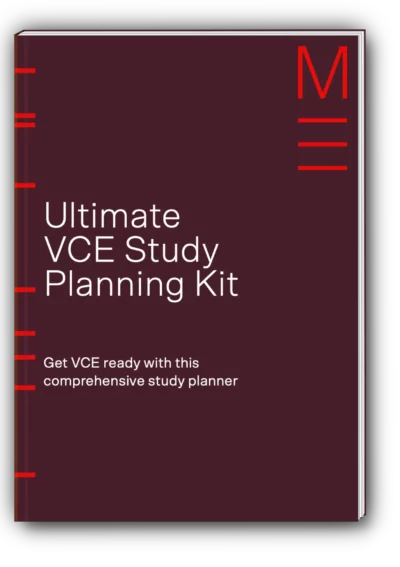
Get VCE ready with our comprehensive study planner.
The VCE journey is long, and the students who do well often have a system that supports them all the way through. This support is what Matrix is built for.
Every Matrix VCE class is taught by a subject specialist who knows the current VCE study design inside out. Our Year 11 and Year 12 English, Maths Methods, Specialist Mathematics, Biology, Chemistry, and Physics teachers write our Theory Books and Work Books to align with the Victorian curriculum, ensuring that students receive the most relevant content and learning experience.
Matrix Term Courses don’t just run alongside the school year – we teach a term ahead! Each week, students attend a structured class, complete set homework, and receive marked feedback before the next lesson. By learning a term ahead, students are familiar with the content before it’s taught at school, allowing deeper engagement and practice in class.
If you’re in Melbourne, you can attend classes at our Box Hill campus. If you live outside of Melbourne or would rather learn from home, the Matrix+ Online course provides you with the same teachers and curriculum, with the flexibility of an on-demand video format.
The VCE is a big change – but it’s one you can prepare for. The earlier you understand how the units fit together, what assessment looks like, and how your ATAR is determined, the more reassured and confident you will feel on your journey ahead.
Ready to dive more into how your ATAR is calculated? Check out our other articles on the VCE:
Written by Matrix Education
Matrix is Sydney's No.1 High School Tuition provider. Come read our blog regularly for study hacks, subject breakdowns, and all the other academic insights you need.
© Matrix Education and www.matrix.edu.au, 2025. Unauthorised use and/or duplication of this material without express and written permission from this site’s author and/or owner is strictly prohibited. Excerpts and links may be used, provided that full and clear credit is given to Matrix Education and www.matrix.edu.au with appropriate and specific direction to the original content.