Welcome to Matrix Education
To ensure we are showing you the most relevant content, please select your location below.
Select a year to see courses
Select a year to see available courses

The beginner’s guide to ATAR & Scaling is an in-depth tutorial on how an ATAR is calculated. This guide covers the process for converting your HSC marks into an ATAR as well as strategies you can implement to take advantage of the scaling of different subjects.
Use our ATAR Calculator to get an estimate of your final ATAR.
A list of the common terms that we use in this guide is provided below:
| Key Term | Explanation |
| Aggregate | The sum of scaled marks in 10 units of ATAR courses consisting of 2 units of English plus the next best 8 units. The aggregate is out of 500, as each unit is equal to 50. |
| HSC mark | The average of HSC Exam marks and moderated school assessment marks. The HSC mark is an indication of your performance in the course. |
| Performance Band | A description of a typical performance by a student based on where their mark falls within an HSC mark range. For a 2 unit course, Band 6 indicates the highest level of performance. The ranges of HSC marks for the bands of 2 unit courses are listed below:
For an Extension course, E4 indicates the highest level of performance. The ranges of HSC marks for the bands of Extension courses are listed below: Extension Courses (except Mathematics Extension 2)
Mathematics Extension 2
Mathematics Extension 2 students have their achievement for both Mathematics Extension 1 and Mathematics Extension 2 reported using four bands but the mark range is out of 100 rather than 50. |
| Scaled mark | The adjusted HSC mark after the scaling process. This is the mark a student would have received if all courses had the same candidature and the same mark distribution. |
Let’s begin by understanding the difference between HSC marks and an ATAR (Australian Tertiary Admission Rank).
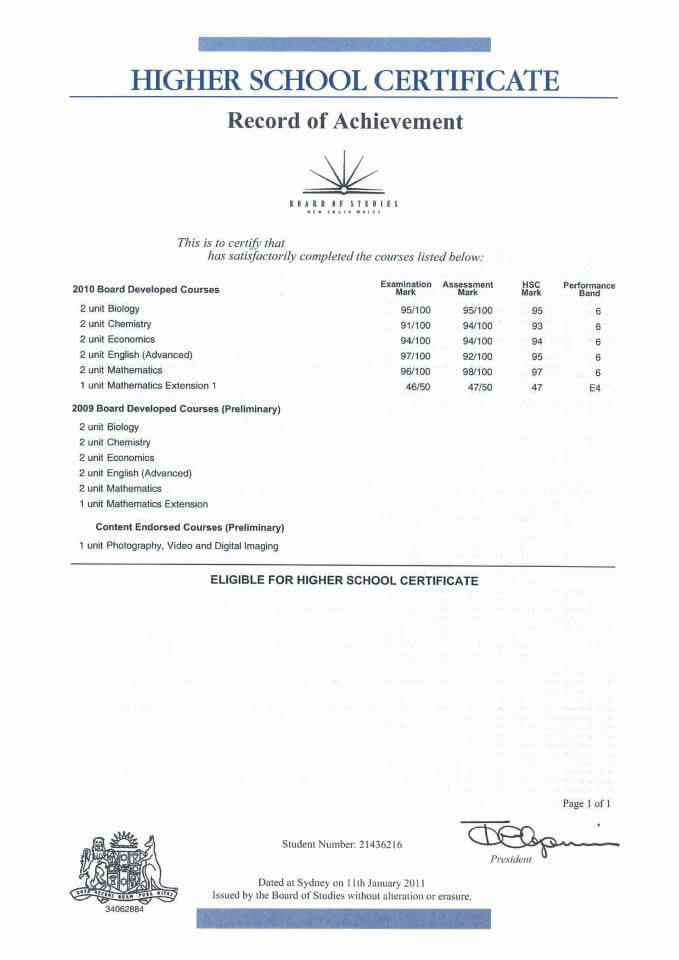
HSC marks provide information about how well you have performed in each of the courses you have completed. So we can better understand this, let’s look at the table below to see what HSC marks are.
| Table: What are HSC Marks? | |
| HSC Mark | |
| What is an HSC mark? | Information about how well you have performed in each course. |
| What does an HSC mark indicate? | Your performance in the different courses. |
| What is the maximum HSC mark attainable? |
|
| Who determines the HSC mark? | NESA (NSW Education Standards Authority) |
| How is it calculated? | HSC Mark is the average of HSC Exam mark and moderated assessment mark. |
You can see a copy of an actual student’s HSC Record of Achievement from NESA (formerly known as Board of Studies) below.
You’ll receive an ATAR (Australian Tertiary Admission Index) after you’ve completed the HSC; all students who sit the HSC receive one. Your ATAR is a number between 0.00 and 99.95 with increments of 0.05. It is a numerical measure of your overall academic achievement in relation to other HSC students.
| Table: What is an ATAR? | |
| ATAR | |
| Acronym | Australians Tertiary Admission Rank |
| What is an ATAR? | Information about how well your have performed overall against other students |
| What does an ATAR indicate? | Position/Rank in relation to Year 7 students you began school with |
| What is the maximum ATAR attainable? | 99.95 (Top 0.05%) |
| How many students can get a 99.95 ATAR? | 40-50 students |
| Who determines the ATAR? | University Admission Centre (UAC) |
Remember, ATAR is a rank and not a mark.
You can see a copy of an actual student’s Australian Tertiary Admission Rank Advice from UAC (The University Admissions Centre) below. The student obtained an ATAR of 99.7. This means this student performed better than 99.7% of their cohort.
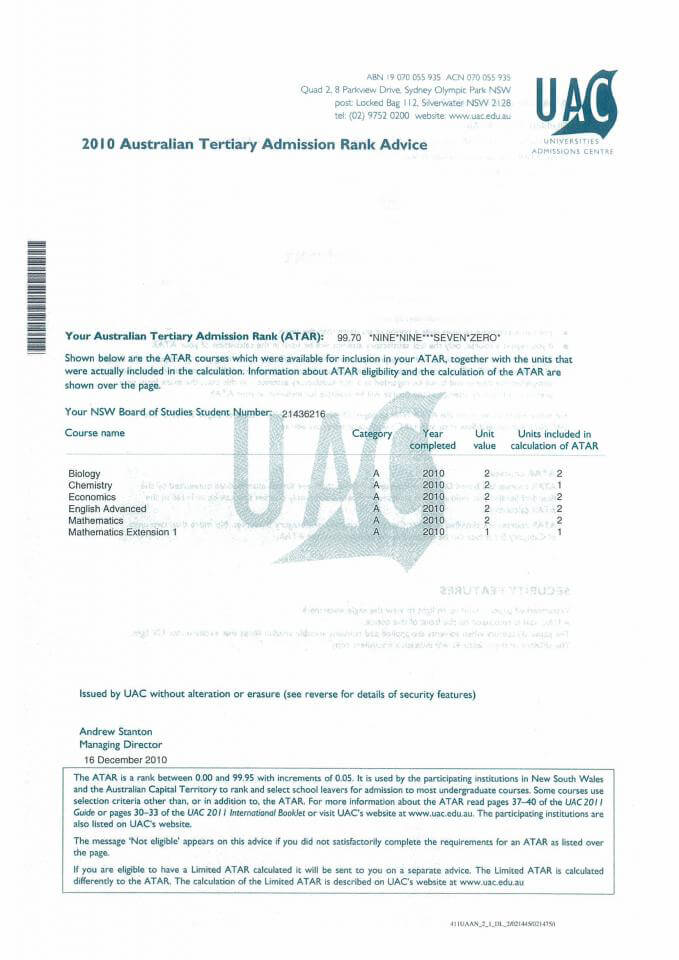
The ATAR allows universities to rank students for selection into their courses. It’s calculated by universities and released by the UAC. Visit UAC website to view cut-offs for different university courses or visit the Matrix ATAR Calculator to get an estimate of your ATAR.
Students study different combinations of HSC subjects. Therefore comparing a student’s overall performance based on HSC marks is difficult.
For example, how would you compare Jack’s result of 95 English Advanced with his friend who scored 97 in English Standard? Who performed better? In order to compare a student’s overall performance fairly and equitably, UAC converts this into a UAC score and then into your ATAR.
Universities use an ATAR on its own or with other selection criteria to rank and select applicants for admission into university courses.
To be eligible for an ATAR you must satisfactorily complete at least 10 units of ATAR courses.
These ATAR courses must include at least:
A student’s ATAR is a rank that is based on an aggregate of scaled marks in 10 units of ATAR courses comprising of:
The flowchart below outlines the process of determining your ATAR.
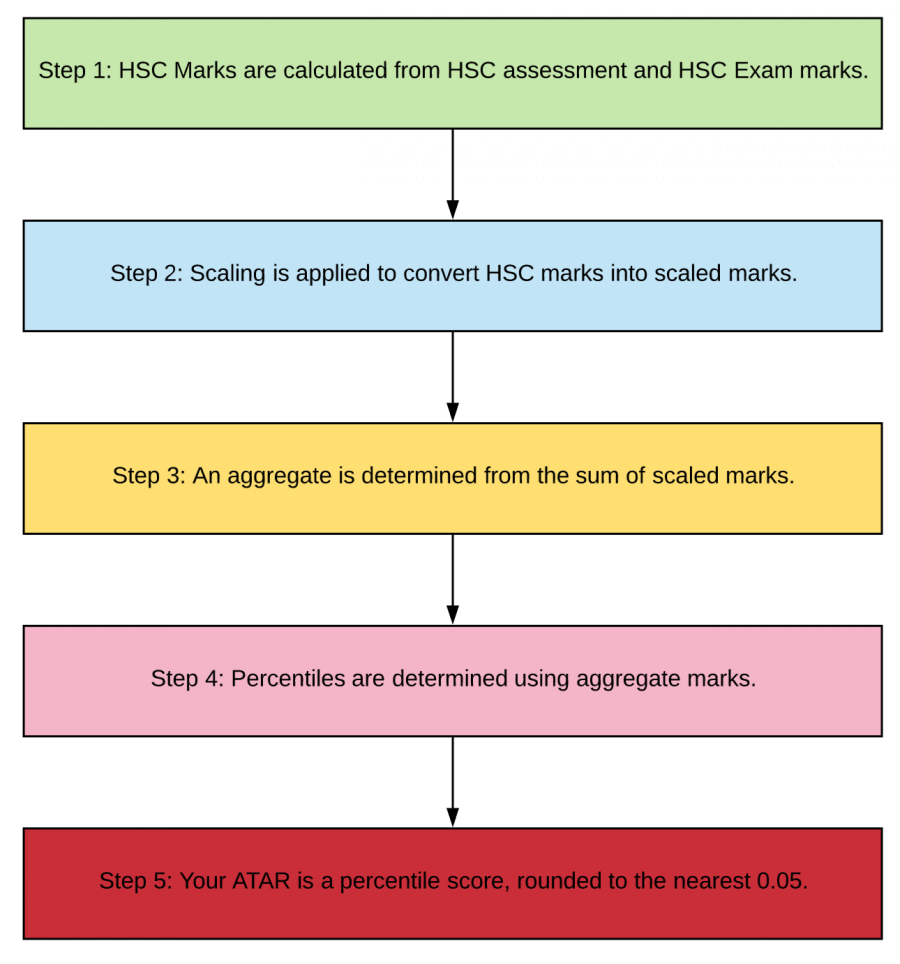
We will explain each step of the process in the following parts:
ATARs allow universities to compare students from different schools, subject combinations, and academic backgrounds using a consistent ranking system.
This system supports fair selection into university programs and helps create equal academic opportunity for all applicants.
There are specific rules set by the University Admission Centre (UAC) that students must meet to qualify for an ATAR, including minimum unit requirements, English study obligations, and course eligibility criteria.
These rules ensure ATARs are calculated using the same academic standards for all students.
Scaling is the process used to adjust raw study marks so results from different subjects can be fairly compared.
Because subjects vary in difficulty and competition levels across schools, scaling helps create a level playing field when calculating ATARs.
Study scores are scaled to account for differences in subject difficulty and student cohorts across the state.
This means a student is not disadvantaged for choosing academically challenging subjects, and their results reflect relative performance more accurately.
Scaling supports fairness and consistency, ensuring all students have equal opportunity, regardless of subject selection.
Scaling takes place after HSC marks are finalised and before ATARs are calculated and released by UAC.
This ensures student results are assessed consistently before university offers, and academic programs are finalised.
Common questions include how subject selection affects scaling, whether results vary between schools, and how ATARs influence access to university programs.
Understanding these processes helps students see ATARs as one of several pathways toward future study and opportunity, rather than a fixed limit on success.
© Matrix Education and www.matrix.edu.au, 2025. Unauthorised use and/or duplication of this material without express and written permission from this site’s author and/or owner is strictly prohibited. Excerpts and links may be used, provided that full and clear credit is given to Matrix Education and www.matrix.edu.au with appropriate and specific direction to the original content.